

Become a
Planet Positive
Mining Fleet
A fraction of your hashrate.
A whole new legacy.
Make a one-time donation of miner NFTs. Use their net Bitcoin rewards to fund mangrove planting over time.
Illustrative share of fleet hashrate.
Donate the miner NFTs once.
Turn a small share of mining power into a planting fund.
Transfer miner NFTs once to Treegens’ charitable recipient. Their net rewards support planting as long as the miners remain productive. The physical mining equipment stays with the operator.
One donation
Agree a one-time transfer of digital miners. No automatic annual repeat donation.
A planting budget
Use the rewards available after costs to pay for planting and agreed verification.
Evidence over time
Publish planting records, review survival and update the funding plan as conditions change.
This is a partnership proposal. Donation terms, operating-cost support and delivery commitments are to be agreed. How GoMining digital miners work
Small inputs. Big differences.
The starting scenario suggests about 0.16% of fleet hashrate donated once. That assumes operating costs are paid separately, a flat reward rate, and the carbon and planting-cost benchmarks below.
Build your scenario
Proposed operator support, not a standard GoMining fee waiver. Any ongoing cost support is additional to the one-time NFT donation.
The original $0.0376 is an illustrative gross hashprice, not a verified current quote. GoMining normally deducts electricity and service fees. Reward and fee formulas
Energy & planting assumptions
The 308 kg benchmark is not validated for these sites and has no survival adjustment in this model. Use a lower effective value to explore uncertainty. $0.10 is Treegens’ stated average planting cost, not an independently checked all-in project budget.
27.28 PH/s in digital miners under this scenario.
*The tree target divides one year’s estimated electricity emissions by a modelled lifetime carbon amount per tree. It does not measure carbon already removed or establish carbon neutrality.
What changes the result?
Half the available yield needs twice the donated hashrate. Half the carbon estimate needs twice the trees. Doubling planting cost doubles the funding requirement.
Future rewards can fall, including to zero. Review the budget annually; the donation does not guarantee permanent funding.
Energy basis: 8,760 hours/year; constant hashrate and efficiency; 100% grid electricity. SRVC 0.269170 and ERCT 0.332874 kg CO₂/kWh, converted from EPA’s 2023 subregion data. These are grid proxies pending site confirmation.
EPA data 308 kg literature benchmark See evidence & limits ↓Grow the forest. Measure the progress.
“Planet Positive” describes the ambition of this proposal. Achieving it requires evidence of net environmental benefit, alongside reductions in mining emissions.
Planting happens now
Fund site-appropriate planting with public records. Agree land access, ecological suitability, seasonal capacity, monitoring and replanting terms before scaling.
Carbon builds over time
The 308 kg benchmark assumes roughly 25 years of growth. It is not annual capture per tree. Actual outcomes depend on site conditions, survival and long-term protection.
Claims follow evidence
Report planted trees, surviving trees and measured carbon separately. This proposal does not issue or retire certified carbon credits, or claim that emissions have already been offset.
Verra’s VM0033 quantifies project-specific net reductions and removals. A per-tree benchmark alone does not demonstrate compliance. Read the methodology
One transfer. A clear path to the ground.
Agree the donation
Confirm miner ownership, transfer eligibility, the recipient’s account and wallet, and who pays operating costs.
Route net rewards
Transfer the agreed miner NFTs once. Allocate the available rewards to planting and the agreed delivery budget.
Plant and document
Record plots with footage and coordinates. Distinguish submitted, AI-counted and verifier-reviewed records.
Review and report
Publish receipts, planting records and survival checks. Revisit yield and targets each year; additional donations require separate agreement.
Treegens publishes filmed plots and counting methodology. AI counts and app submissions are not automatically independent verification or evidence of long-term survival. Explore Proof of Tree
A charitable gift, with the details handled properly.
The proposal assumes an eligible US 501(c)(3) receiving charity, as confirmed by Treegens. The Foundation’s legal name, EIN and determination letter belong in the final donation documents.
Valuation and documentation
Deductibility depends on the donor, the asset’s tax character and the transaction. A holding period over one year alone does not settle every miner NFT’s treatment. A charity’s receipt is separate from the donor’s qualified appraisal.
For digital-asset deductions above $5,000, the IRS generally requires a qualified appraisal. Substantiation and Form 8283 requirements also apply.
IRS digital-asset donation guidanceCorporate deduction limits
For tax years beginning after 2025, the general corporate charitable deduction rules include a 1% taxable-income floor and a 10% ceiling, with conditional carryforward rules. A deduction reduces taxable income; it is not a reimbursement of the gift.
The donor’s advisers should also assess any sponsorship benefits and the recipient’s treatment of ongoing mining income before transfer.
26 USC §170Give people something they can follow.
A public impact page
Proposed: a GoMining × Treegens page with funded planting records, evidence links and review status.
An annual impact report
Proposed: reconcile net rewards, expenditure, planting and survival, with carbon estimates shown separately.
A story from the field
Proposed: planting footage and a joint announcement based on achieved milestones. Event participation and branding rights would be agreed separately.
Local planting. International conversations.
The GROWalition reports engagement with government representatives from Nigeria, Ethiopia and Indonesia. These supplied meeting photographs document the campaign’s outreach; they do not establish a signed government commitment to this mining proposal.

Nigeria
Treegens-supplied campaign photograph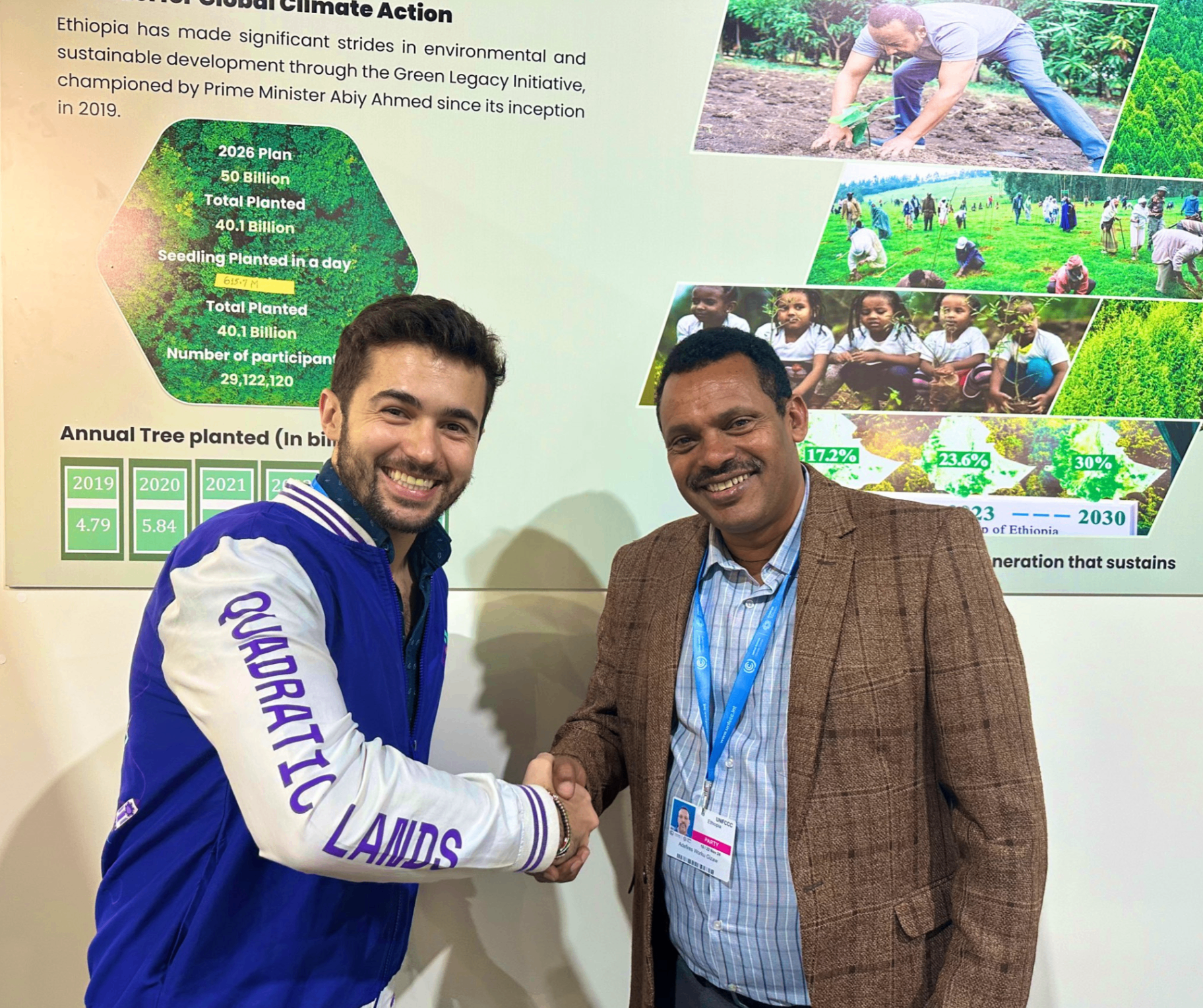
Ethiopia
Treegens-supplied campaign photograph
Indonesia
Treegens-supplied campaign photographGROWalition’s account of its outreach
Seedlings reported in one day
Ethiopian News Agency reports that Prime Minister Abiy Ahmed announced 805.3 million seedlings planted on 3 August 2026. This is a national government-reported planting total, not a verified survival count or a Treegens-attributable total.
Read the 3 August 2026 reportThe sources behind the story.
Reviewed 11 September 2026. Public facts, modelling assumptions and proposed commitments are labelled separately so you can inspect what supports each claim.
Electricity emissionsPrimary data · scenario inputs
EPA eGRID2023 Rev 2 gives SRVC 593.419 and ERCT 733.862 lb CO₂/MWh. Converted factors are used without intermediate rounding. Fleet size, location split, 25 J/TH efficiency and 7% overhead come from the supplied proposal and remain unconfirmed operating data. Electricity CO₂ excludes other greenhouse gases, transmission losses, hardware production and other emissions.
EPA summary tables308 kg CO₂ per mangrovePublished benchmark · site validation needed
A 2023 maritime-emissions study uses 308 kg per tree over 25 years. The cited Eden benchmark assumes 840 tonnes of carbon per hectare and 10,000 trees per hectare. These are forest-stock assumptions, not measurements of additional removal at Treegens sites. Baselines, survival, density and permanence must be assessed before making an offset claim.
Read the study, section 3.4 Original Eden benchmarkOne-time donation and fundingVerified mechanics · illustrative economics
GoMining documents digital miners backed by physical computing power and daily Mining Mode rewards. Electricity and service fees reduce rewards. The model’s $0.0376 gross rate is illustrative; the 0.16% scenario requires costs paid separately. The percentage refers to hashrate, not the number of NFTs or their market value.
GoMining reward and fee documentationPlanting price and proofTreegens-stated · project terms to agree
Treegens describes $0.10 as an average planting cost, not an all-in named-tree invoice. It publishes filmed, GPS-tagged plots with AI counts and review status. Funded, planted, counted, verified and surviving trees should be reported distinctly. Capacity, monitoring and replacement costs require a delivery agreement.
Treegens public informationGovernment commitments and recordsAttributed · limited corroboration
The government outreach claims are published by GROWalition; signed commitments to this proposal were not available for review. Treegens reports Jimi Cohen’s 30,469-mangrove achievement in 2024. The current Guinness page lists Antoine Moses with 47,460 on 30 April 2026; Jimi’s achievement must not be described as the current individual record.
Current Guinness record listingTax and charity statusCurrent rules · recipient assumed
The receiving 501(c)(3) is an owner-confirmed proposal assumption, not an independent IRS status verification here. The updated corporate rules and digital-asset appraisal guidance are linked above. Donor identity, asset classification, valuation and eligibility need transaction-specific review.
IRS donor documentation guidanceAgree the inputs. Then set the target.
Fleet & rewards
Confirm actual power consumption, site grid regions, miner efficiency, net reward history and operating-cost support. The default fleet scenario is not an audited GoMining inventory.
Sites & survival
Confirm planting areas, community agreements, seasonal capacity and the cost of monitoring and replacement. Replanting is a proposed commitment, not a measured 100% survival rate.
Recipient & reporting
Confirm charity documents, wallet controls, appraisal, reward accounting and reporting schedule. Agree the scope and value of any partner benefits.
The questions that matter.
Is the donation repeated every year?
No. The proposed transfer of miner NFTs happens once. Their net rewards then fund planting. Any operator-paid running costs are a separate ongoing commitment; any extra NFT donation must be agreed separately.
Can we say “under 0.2% offsets 100% forever”?
The model does not support that guarantee. About 0.16% is a conditional funding scenario using a lifetime carbon benchmark. It does not prove immediate or permanent emissions compensation.
What if mining rewards fall?
The planting budget falls unless reserves or separately agreed support cover the difference. Neither a larger initial donation nor a future Bitcoin halving scenario guarantees a fixed planting programme.
Does this depend on buying $MGRO?
No token purchase is required by this proposal. Treegens describes $MGRO as a record of a mangrove grown for at least three years and lists its purchase pool as not yet live. Planting evidence and donated-miner accounting should stand on their own.
- 0120-minute call to walk the numbers and agree fleet efficiency.
- 02Confirm fleet electricity, site locations and net miner rewards using operating records.
- 03Agree the one-time NFT donation size, fee arrangements and annual planting budget.
- 04The donor’s advisers confirm recipient eligibility, structure, valuation and documentation.
- 05Agree transfer, planting, monitoring and reporting milestones before launch.
- 06Publish the agreed partnership and report progress against evidence from the field.